
Saturday, August 30, 2008

Talking Points on Nation Branding
What is Nation Branding and what are the benefits?
The concept of nation branding was elaborated by Simon Anholt in 1998 through his article “Nation Brands of the 21st Century” in the Journal of Brand Management where he pointed out that “brands create a value that is invisible”. Anholt, a market researcher from the corporate sector, reckons that brand is a “multiplier of value and as such represents a substantial advantage for its owner; it is as good as money in the bank.”
Recently I have come across many articles, blog posts and other documentation that suggest that Branding or Re-Branding Bangladesh would have a positive economic effect in Bangladesh. I have asked the public for the opinion and it's astounding to me that no one commented or gave an opinion.
The article (yet another) below elaborates a bit on Nation Branding and appeared in the Daily Star Newspaper in Bangladesh in July:
Rebranding Bangladesh
Mamun Rashid
My friend and teacher, Professor Ferhat Anwar, may be angry with me, for it is premature to 're-brand' Bangladesh, when we are only at the primary stages of 'branding Bangladesh'. But my humble arguments for him would be-- take it or leave it.
Bangladesh has already been branded as a corrupt, natural calamity prone, weak-governance plagued poor country, therefore, we need to share the story of a new Bangladesh, a forward-looking Bangladesh, identified and doing its home work specific for a middle income country, where its entrepreneurship will be highlighted, resilience talked about, success in poverty alleviation, religious and political harmony discussed and cultural homogeneity respected.
The international community is noticeably hesitant to acknowledge several of our achievements in the last few decades even though these achievements are considerably better than many other countries which the world views favorably. However, it would be self-defeating for us to act like a cry-baby and blame the international community for this unfair treatment. We have to admit that we have a problem in projecting the country and the true spirit of its people. This incapability of ours creates the necessity to focus on `re-branding' Bangladesh.
In developing a brand identity for Bangladesh, we must understand what we really understand by the term 'branding'. Commercial brand management is basically a process of marketing management by the seller of a product to enhance the value of the product or to create differentiation with the competitors. Marketing guru Philip Kotler explained that a brand is basically a seller's promise to deliver a specific set of features, benefits, and services consistently to the buyers. It can convey up to six levels of meanings: attributes, benefits, values, culture, personality, and user. The branding challenge is to develop a deep set of positive associations for the brand. A marketer must decide at which level or levels of meaning to anchor the brand identity.
Nation branding is basically a derivative from the commercial brand management process, which aims to measure, build, and manage the reputation of countries. It applies some approaches from commercial brand management practice to countries, in an effort to build, change, or protect their international reputations or external perception at the minimum. It is based on the observation that the 'brand images' of countries are just as important to their success in the global market place as those of products and services. Simon Anholt is normally credited as a pioneer in this field. Nation branding appears to be practiced by many states, including US and UK (where it is officially referred to as Public Diplomacy) and most West European countries. There is increasing an interest in the concept from less developed countries to create more favorable conditions for foreign direct investment, tourism, trade, and even political relations with other countries.
We should focus on developing our own brand. What factors should drive the case of our branding? How should it be driven?
The key to attaining an effective brand identity is to activate adequate positive associations with all these experiences, good or bad. For an example, we are known all over the world for the sufferings and destruction we face due to natural calamities year after year. However the same incident could have been transformed into a major brand identity if we could have positively associated the courage, commitment, and resilience of our people who even after all these natural disasters have continued to develop the country with some remarkable achievements.
We have invented micro-credit to fight our own poverty and are willing enough to share it with the rest of the world. We are competing with the giants of the world in the ready-made garments market and successfully growing each year. We have continuously faced obstacles, but we have not removed ourselves from the path to our destination. Thousand years of culture and civilisation has given our people the ability to dream with which we fight against all adversities.
Driving the process of building brand for a country is a much bigger effort than any other commercial product. It requires a true common representation of the aspiration of the people of the country. People of the country must be able to believe in the image projected by the brand proposition.
That is why re-branding Bangladesh will have to be driven from various forums -- the government, political parties, civil society, media, professionals, private sector, workers and farmers, urban and rural people, etc. When all of us can share the common minimum identity, we shall be able to establish Bangladesh as rejuvenated brand equity. We need to send a message to the international community that we mean business, we encourage entrepreneurship and wealth creation, we are committed to create enough economic activities to eradicate poverty, there is policy continuity despite change of the government and democracy means the same thing here as elsewhere.
I would conclude again with a quote from my teacher and `Guru' of the marketing world Philip Kotler- "Bangladesh is at the stage where its business and government personnel need to develop a dynamic marketing mindset regarding problems and opportunities that they face. Marketing is a mindset. Bangladesh must also move to this mindset whose mantra is 'Create Superior Value for Chosen Groups of Customers'. You need to turn your mind to think about consumer and business needs and find ways to offer more value than your competitors. I hope that you will succeed.”
The writer is an economic analyst.
__________________________________________________________________
Again, I refer to the article written by Ifty Islam that lays out the numerous reasons why this is so important. His article also appeared the Daily Star this August
The importance of defining Brand Bangladesh
Ifty Islam
The Incredible India campaign has been a huge success. Bangladesh is still searching to determine its brand, a good tool in raising positive awareness about the country.
In 2007 Vietnam attracted Foreign Direct Investment (FDI) flows of $ 20bn and if Bangladesh is to benefit from the surge in global investor interest in Asia, we need to address the key questions of “Why Bangladesh? Why Now?”. A new and effective strategy for developing Brand Bangladesh will be a critical part in credibly answering these questions.
One report from leading brand consultants Interbrand, defined Nation Branding as “the ability to act and speak in a coordinated and repetitive way about the themes that are the most motivating and differentiating a country can make.” There is actually a ranking, the Anholt Nation Brand Index, which has the UK, Germany and France leading a list of 38 countries. The 2007 Report noted “Globalisation means that countries compete with each other for the attention, respect and trust of potential customers, investors, tourists…a strong and positive nation brand provides a crucial competitive image.”
I recently had the pleasure of being interviewed by a number of final year IBA students who were completing a thesis on national branding. I suggested that we start by playing a word association game to decide what “Brand Bangladesh” is, which is clearly a necessary pre-requisite to deciding what we want it to become.
We collectively tried to summarize what the rest of the world thinks when they hear the word “Bangladesh”. The five leading candidates were 1) Natural Disasters; 2)Poverty ; 3)Political Instability ; 4)Corruption; and 5) Grameen/Professor Yunus. Clearly 4 negative connotations offset by an example of Bangladesh's considerable contribution to the world.
The next question I had for the students was what words would we like the rest of the world to think when they heard “Brand Bangladesh”. We concluded with five new themes: 1) Adjacency to India and China; 2) A young, dynamic and entrepreneurial population of 150mn people; 3) A land of innovation in micro finance with the Grameen revolution and Professor Yunus; 4) Untapped opportunities for global investors looking for a new economic platform in the heart of Asia; 5) Substantial and largely untapped intellectual/commercial capital from Non-Resident Bangladeshi (NRB) platform. At least these offer some food for thought as to what Bangladesh should be and I'm sure a number of you have more suggestions.
We can agree “Brand Bangladesh” is important and we have begun to think about what we do and don't want it to be. But how do we go about marketing? There is a lot more resources available than is commonly assumed. Yes the Board of Investment and Parjatan and other Government agencies are stretched. But we have in reality hundreds of thousands and perhaps millions of “Brand Ambassadors” at our disposal - the large NRB community. We just need to find an effective strategy to leverage it. This might involve creating an NRB database and greater support and encouragement for events like the Asia Society seminar held in New York last month that was, in fact, co-organized by NYBAP, an NRB professional's organisation. Government, possibly, with some support from multilateral agencies, should fund a professional marketing campaign. It will be money well spent.
So what should our slogan be in the light of “Malaysia, Truly Asia” and “Incredible India”? While I am as much a fan of alliteration as the next man, I came up with the following three possibilities:
1) “Bangladesh, the Next Asian Tiger”
2) “Bangladesh, the Emerging Asian Tiger”
3) “Bangladesh, at the Heart of Asia”
I have a slight preference for the first I must confess combining the themes of Bengal Tiger, Asia (very popular with investors) and a sense of forward thinking.
In the interests of democracy and for a little fun, might I suggest we vote on it. Please send your preferences among the three alternatives above, and indeed any other catchphrases you think are better, to info@at-capital.com and I will reveal the results in my next column in two weeks time.
If Bangladesh is to emulate the fastest growing neighbours in the rest of Asia, we need to take the challenge of defining and marketing “Brand Bangladesh” seriously. There are likely to be differences between the brand strategy for attracting investment versus tourism but we need as a country to agree what the broad themes.
I look forward to hearing and sharing the responses from my fellow “Brand Ambassadors”.
Ifty Islam is the Managing partner of Asian tiger capital partners and formerly Managing Director and head of global macro strategy at citigroup, London.
__________________________________________________________
Many people may wonder what the big deal is and why I (and countless others) are stressing about this topic. Branding can build a nation, the right branding that is. Right now Bangladesh is stagnating under a bad label (brand).
What do people envision when they hear the mere word "Bangladesh"?
Third World Country, Poor people, devastation by floods, and maybe they remember Dr. Yunus is from Bangladesh and won the Nobel Prize for microcredit (giving loans to poor villagers struggling to run businesses).
What is positive about that picture? Nothing.
___________________________________________________________
I suggest reading the following article written by Ehsan Imdad, Ph.D. who was a presenter at last year's NRB conference and the Author of "The Art of Marketing Communication and Corporate Culture".
Let's build a better Bangladesh together, a good brand is the first step towards a brighter tomorrow. Please leave a comment, suggestion or anything you'd like to say.
Monday, August 25, 2008
Re-Branding Bangladesh Contest - What's Your Choice?
So, my question is for how long will we allow Bangladesh to be known by Micro Credit, Flood, Famine and Professor Yunus? If you love Bangladesh, as I do then you know it has many great things going for it, but it could be so much more.
Is this really what we want for Bangladesh, to create a Poverty Museum that will continue to instill in the minds of the world our depressing history of taking money (micro credit):
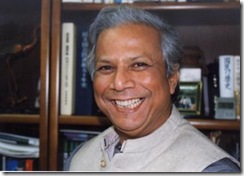
Dr. Muhammad Yunus: The Poster boy of Brand Bangladesh
A bare utterance is being transformed into a reality. The famous saying of Dr. Muhammad Yunus (Nobel Prize-winning founder of Bangladesh’s Grameen Bank) that “We will create a poverty museum by 2030…We will start with Bangladesh” finally goes global with his pioneering micro-credit scheme to poor people with no bank account or credit history. A bank from a “third world country” is making inroads into the world’s richest country: the United States. Grameen America which launched in January 2008, has already lent a modest $145,000 to immigrant women in New York City.
Since at least 2005 the blogging world has been writing and suggesting a new brand for Bangladesh an example is 3rd World View's 2005 Blogspot Post. Also, if you Google search Branding Bangladesh in any search engine, you will find a lot of great information.
Google Search provides this result: Google Branding Bangladesh
Yahoo provides this: Yahoo Search
And there are many more.
So, how long to we want to be the orphan child with the depressing outlook. Don't we want to be like India, Thailand, Malaysia and the many others who have changed their destiny and economic outlook simply by re-branding themselves?

The importance of defining Brand Bangladesh - This article really hits the reasons that Bangladesh needs to act now to change its Brand. Important, economic reasons that the Government should take very seriously.
Here is another opinion in his write up called simply Branding Bangladesh, though I think he has over simplified the way and the reasons.
And finally, I would like to share the following report with you:
_______________________________________________________________________________________________
In Search of Another “Brand” for Bangladesh
Debapriya Bhattacharya
Executive Director
Centre for Policy Dialogue (CPD)
Addressing Perceptions and Realities
Novelist Arnold Bennett (1861-1931) once made the point that “it is difficult to make a reputation, but it is even more difficult to mar a reputation once properly made - so faithful is the public.” Bangladesh, regrettably, faces a reputation challenge which is popularly known as its “image problem”. Thus we observe that the country is being regularly ranked at the low end by organisations as diverse as the World Economic Forum, UNDP, UNCTAD, Transparency International, Freedom House, and Goldman & Sachs. These rankings are usually based on a mix of objective measures and stakeholder perceptions.
The fundamental prerequisite for changing perceptions about Bangladesh would be to change the unfavorable realities prevailing in the country. However, improvement of the reality needs to be supplemented by an effective communication strategy which will adequately transmit the primary strength of the country to the world at large. Indeed, the concept of “branding” may be effectively utilised to address both the reality and perception challenges which Bangladesh is currently confronting.
The Concept of Nation Branding
The concept of nation branding was elaborated by Simon Anholt in 1998 through his article “Nation Brands of the 21st Century” in the Journal of Brand Management where he pointed out that “brands create a value that is invisible”. Anholt, a market researcher from the corporate sector, reckons that brand is a “multiplier of value and as such represents a substantial advantage for its owner; it is as good as money in the bank.”
It is said that a country cannot be sold like a toothpaste. Thus, nation branding is not about pretending that everything is fine in a country, nor is it about discouraging investors and tourists from coming into the country. It is about letting others know about the talents and the opportunities that a country is endowed with. Accordingly, nation branding requires a broader definition of the term “branding” that includes a plan for earning reputation. Indeed, one needs to inspire and induce majority of the citizens to act in a way that helps the country to earn a reputation and make sure that the world knows about it and believes in it.
Anholt introduced in 2005 the Anholt-GMI Nation Brand Index along with GMI, an e-business solution provider. Based on responses from about 25,900 consumers drawn from 35 countries, the index provided a score addressing six core areas of a country depicted through a hexagon:Tourism, Culture, Governance, Exports, People and Investment. The top 10 countries (in descending order) were: UK, Switzerland, Canada, Italy, Sweden, Germany, Japan, France, Australia and USA.
Branding Bangladesh
Nation branding is not yet given much attention in the middle and low income countries. But if a country opts not to have a branding strategy, it does not mean that others will leave it alone. Rather, disadvantaged countries like Bangladesh will be left to the discretion of others and get “branded” based on limited and partial or biased information. Remaining cognisant of this, emerging economies are increasingly addressing the issue of nation branding in a pro-active manner. For instance, in the region, India is recreating its image as the hub of IT based industries and services as well as a major source of skilled manpower. Even small countries, like Bhutan,may use their image of being small, unique, unspoiled and fragile that is envied by the developed world.
Till date, Anholt Index does not include Bangladesh. But as Bangladesh progresses, it will definitely generate enhanced interest in the global community and the sponsors of the index will be inclined to include the country in its exercise. In this connection, a limited survey carried out by CPD among a set of young professionals ranked the six core areas of brand reputation in the following descending order of strength: People, Exports, Culture, Tourism, Investment and Governance. Incidentally, the numerical distance of the weakest area (governance) was substantial from the rest. One wonders whether the expatriate consumers will agree with this ordering.
Bangladesh will be well advised to develop a branding strategy which would expose convincingly and continuously, its natural and acquired strengths, without underplaying the need to effectively deal with the structural and policy weaknesses. A government-corporate partnership, underpinned by active involvement of the civil society, may be forged to articulate an operational plan in this regard.____________________________________________________________________________
The best is alway last, this write up is really the best (you’ll need Adobe Acrobat to open the link. Branding Bangladesh Article by Ehsan Imdad
________________________________________________________________So, now how do we Brand Bangladesh? Is she "Bangladesh - the heart of Asia" or "Bangladesh - Undiscovered Gem of Asia"? What's your choice, your favorite?
Or do you think Bangladesh should continue to be the poster child for poverty, micro credit, floods (even though Bangladesh is not the country with the highest amount of flooding annually), and Professor Yunus ( no offense, he is a great person)? What's your opinion?
Leave me a comment with what you think to see it posted here. Let the people speak out loud!
Subscribe to:
Posts (Atom)
