
So, my question is for how long will we allow Bangladesh to be known by Micro Credit, Flood, Famine and Professor Yunus? If you love Bangladesh, as I do then you know it has many great things going for it, but it could be so much more.
Is this really what we want for Bangladesh, to create a Poverty Museum that will continue to instill in the minds of the world our depressing history of taking money (micro credit):
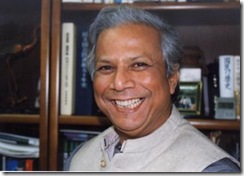
Dr. Muhammad Yunus: The Poster boy of Brand Bangladesh
A bare utterance is being transformed into a reality. The famous saying of Dr. Muhammad Yunus (Nobel Prize-winning founder of Bangladesh’s Grameen Bank) that “We will create a poverty museum by 2030…We will start with Bangladesh” finally goes global with his pioneering micro-credit scheme to poor people with no bank account or credit history. A bank from a “third world country” is making inroads into the world’s richest country: the United States. Grameen America which launched in January 2008, has already lent a modest $145,000 to immigrant women in New York City.
Since at least 2005 the blogging world has been writing and suggesting a new brand for Bangladesh an example is 3rd World View's 2005 Blogspot Post. Also, if you Google search Branding Bangladesh in any search engine, you will find a lot of great information.
Google Search provides this result: Google Branding Bangladesh
Yahoo provides this: Yahoo Search
And there are many more.
So, how long to we want to be the orphan child with the depressing outlook. Don't we want to be like India, Thailand, Malaysia and the many others who have changed their destiny and economic outlook simply by re-branding themselves?

The importance of defining Brand Bangladesh - This article really hits the reasons that Bangladesh needs to act now to change its Brand. Important, economic reasons that the Government should take very seriously.
Here is another opinion in his write up called simply Branding Bangladesh, though I think he has over simplified the way and the reasons.
And finally, I would like to share the following report with you:
_______________________________________________________________________________________________
In Search of Another “Brand” for Bangladesh
Debapriya Bhattacharya
Executive Director
Centre for Policy Dialogue (CPD)
Addressing Perceptions and Realities
Novelist Arnold Bennett (1861-1931) once made the point that “it is difficult to make a reputation, but it is even more difficult to mar a reputation once properly made - so faithful is the public.” Bangladesh, regrettably, faces a reputation challenge which is popularly known as its “image problem”. Thus we observe that the country is being regularly ranked at the low end by organisations as diverse as the World Economic Forum, UNDP, UNCTAD, Transparency International, Freedom House, and Goldman & Sachs. These rankings are usually based on a mix of objective measures and stakeholder perceptions.
The fundamental prerequisite for changing perceptions about Bangladesh would be to change the unfavorable realities prevailing in the country. However, improvement of the reality needs to be supplemented by an effective communication strategy which will adequately transmit the primary strength of the country to the world at large. Indeed, the concept of “branding” may be effectively utilised to address both the reality and perception challenges which Bangladesh is currently confronting.
The Concept of Nation Branding
The concept of nation branding was elaborated by Simon Anholt in 1998 through his article “Nation Brands of the 21st Century” in the Journal of Brand Management where he pointed out that “brands create a value that is invisible”. Anholt, a market researcher from the corporate sector, reckons that brand is a “multiplier of value and as such represents a substantial advantage for its owner; it is as good as money in the bank.”
It is said that a country cannot be sold like a toothpaste. Thus, nation branding is not about pretending that everything is fine in a country, nor is it about discouraging investors and tourists from coming into the country. It is about letting others know about the talents and the opportunities that a country is endowed with. Accordingly, nation branding requires a broader definition of the term “branding” that includes a plan for earning reputation. Indeed, one needs to inspire and induce majority of the citizens to act in a way that helps the country to earn a reputation and make sure that the world knows about it and believes in it.
Anholt introduced in 2005 the Anholt-GMI Nation Brand Index along with GMI, an e-business solution provider. Based on responses from about 25,900 consumers drawn from 35 countries, the index provided a score addressing six core areas of a country depicted through a hexagon:Tourism, Culture, Governance, Exports, People and Investment. The top 10 countries (in descending order) were: UK, Switzerland, Canada, Italy, Sweden, Germany, Japan, France, Australia and USA.
Branding Bangladesh
Nation branding is not yet given much attention in the middle and low income countries. But if a country opts not to have a branding strategy, it does not mean that others will leave it alone. Rather, disadvantaged countries like Bangladesh will be left to the discretion of others and get “branded” based on limited and partial or biased information. Remaining cognisant of this, emerging economies are increasingly addressing the issue of nation branding in a pro-active manner. For instance, in the region, India is recreating its image as the hub of IT based industries and services as well as a major source of skilled manpower. Even small countries, like Bhutan,may use their image of being small, unique, unspoiled and fragile that is envied by the developed world.
Till date, Anholt Index does not include Bangladesh. But as Bangladesh progresses, it will definitely generate enhanced interest in the global community and the sponsors of the index will be inclined to include the country in its exercise. In this connection, a limited survey carried out by CPD among a set of young professionals ranked the six core areas of brand reputation in the following descending order of strength: People, Exports, Culture, Tourism, Investment and Governance. Incidentally, the numerical distance of the weakest area (governance) was substantial from the rest. One wonders whether the expatriate consumers will agree with this ordering.
Bangladesh will be well advised to develop a branding strategy which would expose convincingly and continuously, its natural and acquired strengths, without underplaying the need to effectively deal with the structural and policy weaknesses. A government-corporate partnership, underpinned by active involvement of the civil society, may be forged to articulate an operational plan in this regard.____________________________________________________________________________
The best is alway last, this write up is really the best (you’ll need Adobe Acrobat to open the link. Branding Bangladesh Article by Ehsan Imdad
________________________________________________________________So, now how do we Brand Bangladesh? Is she "Bangladesh - the heart of Asia" or "Bangladesh - Undiscovered Gem of Asia"? What's your choice, your favorite?
Or do you think Bangladesh should continue to be the poster child for poverty, micro credit, floods (even though Bangladesh is not the country with the highest amount of flooding annually), and Professor Yunus ( no offense, he is a great person)? What's your opinion?
Leave me a comment with what you think to see it posted here. Let the people speak out loud!


No comments:
Post a Comment